
12 MIN READ
Sheet Metal Fabrication vs. Stamping: Cost, Volume & Tooling Comparison Guide
An engineering guide for procurement managers and mechanical engineers evaluating breakeven volumes, tooling costs, lead times, and DFM tradeoffs between laser cutting/bending and hard stamping dies.
Key Takeaways for Procurement & Engineering Teams
- Breakeven Volume Threshold: Sheet metal fabrication (laser cutting + press brake) is far more economical for low-to-medium volumes (1 to 5,000 units/year) with $0 tooling cost. Stamping becomes cost-effective for high volumes (>10,000 units/year) where low piece price amortizes hard progressive tooling ($5,000–$50,000+).
- Time-to-Market: Flexible sheet metal prototypes and production parts can be delivered in 3 to 7 days, whereas custom stamping tooling requires 4 to 8 weeks for die design, CNC machining, wire EDM, and T1 sample approval.
- Design Flexibility: Sheet metal allows instantaneous CAD drawing modifications without tooling revision charges. Stamping die modifications require costly tool steel re-machining or wire EDM work.
- Part Unit Cost: Stamping achieves a significantly lower piece price per part at high volumes due to rapid stroke cycle times (30–120 strokes/min) compared to laser cutting and manual/robotic press brake bending.
Navigating the Strategic Sourcing Crossroads
When sourcing custom metal brackets, enclosures, or structural hardware from China, one of the most critical decisions faced by procurement managers is selecting the correct manufacturing process: Flexible Sheet Metal Fabrication or Hard Metal Stamping.
Making the wrong choice can either lock up tens of thousands of dollars in unamortized NRE (Non-Recurring Engineering) tooling dies or result in unnecessarily high piece-part prices that erode product margins. This guide breaks down the financial, technical, and operational factors to help you make data-driven sourcing decisions.
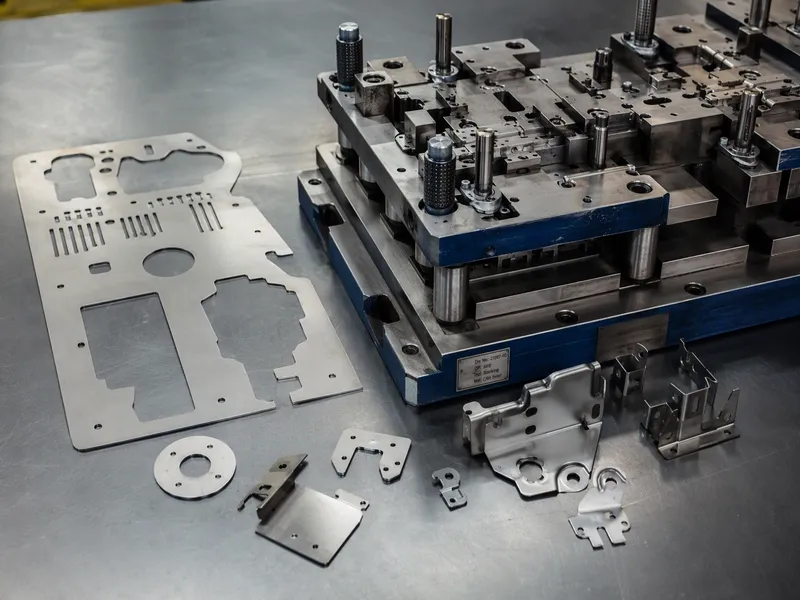
Flexible Sheet Metal Fabrication: Agility & Zero Tooling
Sheet metal fabrication relies on CNC-controlled high-wattage fiber laser cutting machines to shear 2D flat profiles, followed by CNC press brake bending machines to form 3D angles and enclosures. Because standard laser beds and universal V-die punch sets are used, there are no custom tooling costs.
| Engineering Attribute | Sheet Metal Fabrication Profile |
|---|---|
| NRE Tooling Investment | $0 Tooling Fee (Standard universal punch/die sets) |
| Prototyping Lead Time | 3 to 7 Days from STEP/DXF file approval |
| CAD Revision Agility | Instantaneous program updates without physical die modifications |
| Optimal Production Run | Low to Medium Volume (1 to 5,000 pcs/year) |
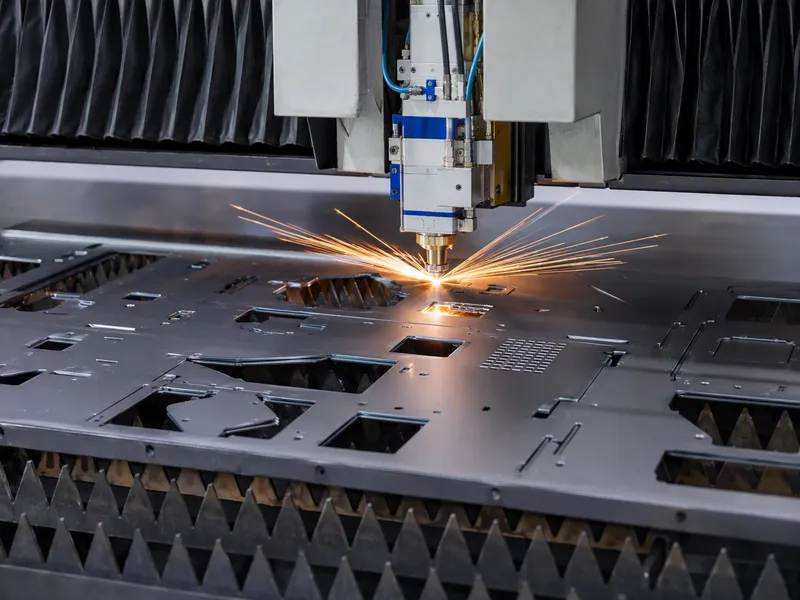
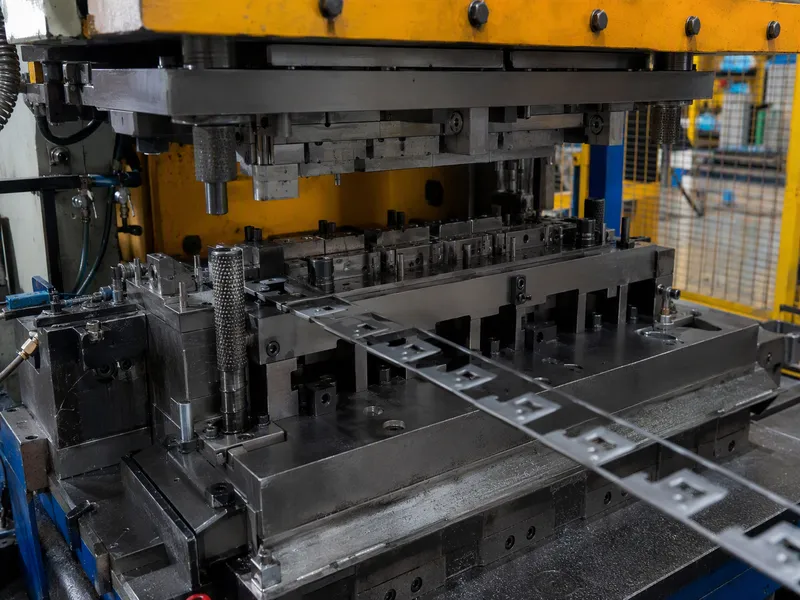
Hard Metal Stamping: High Speed & Ultra-Low Piece Price
Metal stamping utilizes custom-built steel tooling dies (progressive dies, transfer dies, or stage dies) mounted in mechanical or hydraulic presses. Coiled sheet steel is fed through the die, performing piercing, blanking, forming, and coining in rapid continuous strokes (30–120 strokes/min).
| Engineering Attribute | Metal Stamping Profile |
|---|---|
| NRE Tooling Investment | $3,000 to $50,000+ per progressive die set |
| Tooling Lead Time | 4 to 8 Weeks for tool steel machining, wire EDM & T1 samples |
| Production Speed | 1,000 to 5,000 parts/hour under continuous automated press runs |
| Optimal Production Run | High Volume (>10,000 to 1,000,000+ pcs/year) |
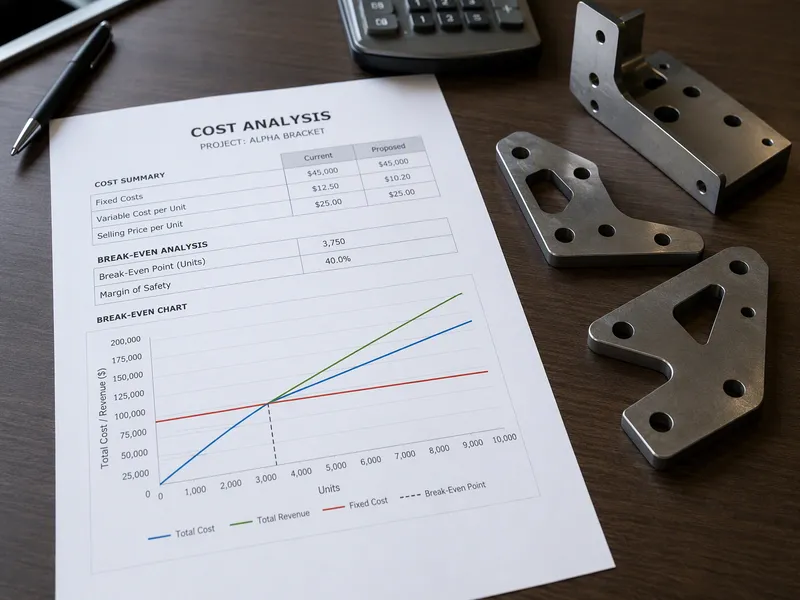
The Breakeven Amortization Formula & Real Case Calculation
To determine whether hard stamping or flexible laser fabrication makes financial sense, procurement teams calculate total project cost (Tooling Cost + Total Piece Cost) across forecasted annual production volumes.
Total Cost Amortization Equation
Total Cost = Tooling Cost + (Volume × Piece Price)
Example: A structural stainless mounting bracket costs $8.00/pc via laser fabrication ($0 tooling). A progressive stamping die costs $12,000 tooling with a piece price of $2.00/pc. The breakeven point occurs at:
$12,000 / ($8.00 – $2.00) = 2,000 units. Below 2,000 units, sheet metal fabrication is cheaper; above 2,000 units, progressive stamping yields net savings.
Sourcing Recommendation Matrix
- Volume < 2,000 units/year: Always choose Laser Sheet Metal Fabrication to eliminate tooling risk.
- Volume 2,000 – 10,000 units/year: Evaluate product design stability. If CAD drawings may change within 12 months, stick with sheet metal fabrication.
- Volume > 10,000 units/year: Invest in progressive stamping dies for maximum long-term unit cost savings.
Hybrid Manufacturing Under One Roof
Conwhole operates both high-power fiber laser cutting / press brake cells and stamping press lines, offering unbiased engineering process selection.
Seamless Prototype-to-Mass Transition
Launch pre-production volumes with zero-tooling laser fabrication, then transition seamlessly to progressive stamping dies as market demand scales up.
In-House Tooling Design & Maintenance
Our tooling engineers design and maintain stamping die sets in-house, offering lifetime die maintenance guarantees for active production parts.
Comprehensive Quality Verification
Every shipment includes CMM dimensional reports, material mill test certs (MTR), and optional FAI / PPAP Level 3 documentation.
Q1: What is the typical lead time for custom progressive stamping die building?
Progressive stamping die building at Conwhole typically takes 4 to 6 weeks, including 3D die CAD design, CNC rough machining, vacuum heat treatment of tool steel (D2/SKD11), precision wire EDM cutting, assembly, and T1 sample trial approval.
Q2: Can I modify my part design after a stamping die has been built?
Minor engineering changes (ECN) such as enlarging hole diameters or shifting hole locations can often be accommodated by re-machining die inserts or wire EDM. However, significant dimensional or geometry modifications may require building new die stations or a new tool steel set.
Q3: How fast can Conwhole deliver prototypes using laser sheet metal fabrication?
For urgent prototype requirements, Conwhole offers accelerated 3-day fast-track laser cutting, press brake bending, and hardware insertion services upon 3D STEP file approval.
Q4: Who owns the stamping die tool after tooling payment?
The customer retains 100% ownership of all custom stamping dies. Conwhole stores, maintains, and insures the tooling dies free of charge for active production orders at our factory facility.
Q5: What material thickness limits apply to sheet metal vs. stamping?
Sheet metal fiber laser cutting handles thick steel plates up to 25mm carbon steel or 20mm stainless steel. High-speed progressive stamping dies are typically optimized for coil stock thicknesses between 0.5mm and 6.0mm.
Q6: Is it possible to start with laser sheet metal fabrication and switch to stamping later?
Yes. This is a recommended sourcing strategy. Launching with laser fabrication eliminates upfront tooling risk while verifying market demand. Once annual volumes exceed 5,000–10,000 units, Conwhole builds stamping tooling to lower unit costs.
Q7: How does material scrap rate differ between the two processes?
Laser cutting uses dynamic software nesting algorithms on large sheet stock to maximize material utilization (scrap rate ~10-15%). Stamping dies require continuous strip carriers and edge margins, resulting in scrap rates between 15% and 35%.
Q8: What quality certifications does Conwhole provide for custom metal hardware?
Conwhole provides full ISO 9001 quality assurance documentation, CMM dimensional measurement reports, material test certs (MTR), and salt spray corrosion test reports for surface-treated hardware.
Unsure Which Manufacturing Process Fits Your Hardware Drawing?
Send your STEP/CAD files to Conwhole engineering team. We will evaluate both laser fabrication and hard stamping options, providing a detailed DFM report and dual-option cost analysis within 24 hours.