
8 MIN READ
Selecting the Right Aluminum Alloy: 6061 vs. 7075 vs. 5052
An engineering guide for procurement managers and mechanical engineers evaluating tensile strength, corrosion resistance, machinability, weldability, and cost for custom aluminum hardware.
Key Takeaways for Procurement & Engineering Teams
- Strength Hierarchy: 7075-T6 delivers roughly 1.6–1.8× the tensile strength of 6061-T6 (~572 vs ~310 MPa), but its corrosion resistance and weldability are significantly worse. Reserve 7075 for load-critical aerospace and structural parts.
- Corrosion & Formability: 5052 (5xxx, Al-Mg) is the marine-grade, deep-draw choice — outstanding saltwater resistance and formability at the lowest cost, but it cannot be heat-treated and machines poorly compared to 6xxx/7xxx.
- Anodizing Quality: 6061 is the best decorative anodizing substrate. 7075 anodizes only fair (high zinc), and 5052 anodizes poorly (high magnesium causes grey discoloration) — use powder coat for 5052 color needs.
- Cost vs. Performance Rule: Specify 5052 for sheet metal/marine/cost-sensitive parts, 6061 for general CNC structural + anodized housings, and 7075 strictly where ultimate strength-to-weight justifies the premium.
The Aluminum Alloy Dilemma in Custom Hardware Sourcing
When designing or sourcing custom CNC-machined parts, sheet metal enclosures, or welded assemblies, selecting the wrong aluminum alloy is one of the most common causes of premature field failure and unnecessary cost. Over-specifying 7075 for benign indoor parts inflates material cost by 40–60%, while under-specifying 6061 or 5052 in high-load or marine environments leads to structural or corrosion failures.
This engineering guide compares 6061, 7075, and 5052 aluminum alloys across tensile strength, corrosion resistance, machinability, weldability, anodizing quality, and cost — to help you match the right alloy to your application.
Conwhole sources certified aluminum stock across all three alloys, so a single drawing can be quoted in 6061, 7075, or 5052 — with material certification and DFM recommendations validated before any part enters production.
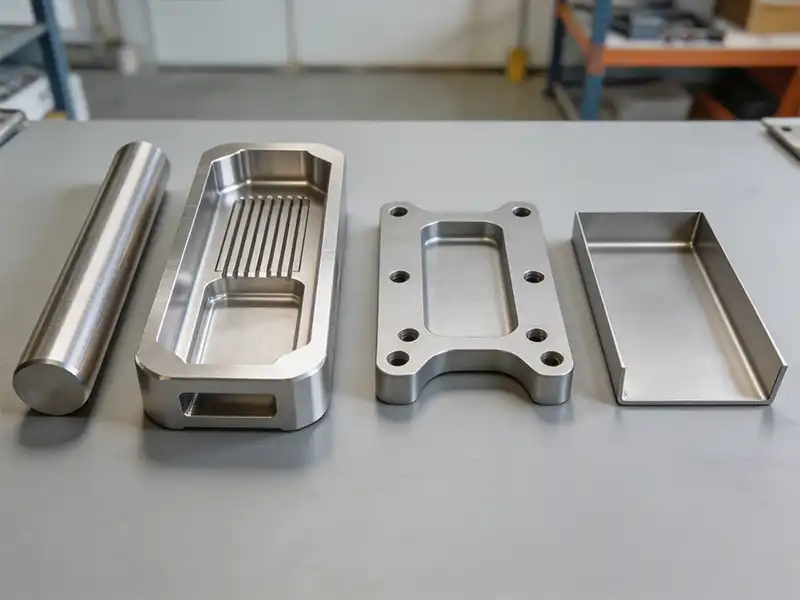
6061 vs. 7075: General-Purpose vs. Aerospace-Grade Aluminum
6061 — The Versatile Workhorse (6xxx)
6061 is the most widely used heat-treatable aluminum alloy, balancing good strength, excellent machinability, weldability, and anodizing response. In T6 condition it reaches ~310 MPa tensile strength, making it the default choice for CNC-machined housings, structural brackets, and decorative anodized parts.
7075 — Aerospace-Grade Strength (7xxx)
7075 is a zinc-alloyed, heat-treatable aluminum delivering ~572 MPa tensile strength in T6 — roughly 1.8× that of 6061. It is the aerospace/defense standard for high-load, weight-critical parts. The tradeoff: poor corrosion resistance (prone to stress-corrosion cracking unless protected) and very difficult welding.
| Property | 6061-T6 | 7075-T6 |
|---|---|---|
| Base Alloy Series | 6xxx (Al-Mg-Si) | 7xxx (Al-Zn-Mg-Cu) |
| Tensile Strength | ~310 MPa | ~572 MPa |
| Yield Strength | ~276 MPa | ~503 MPa |
| Corrosion Resistance | Good | Poor (SCC sensitive) |
| Weldability | Good | Poor |
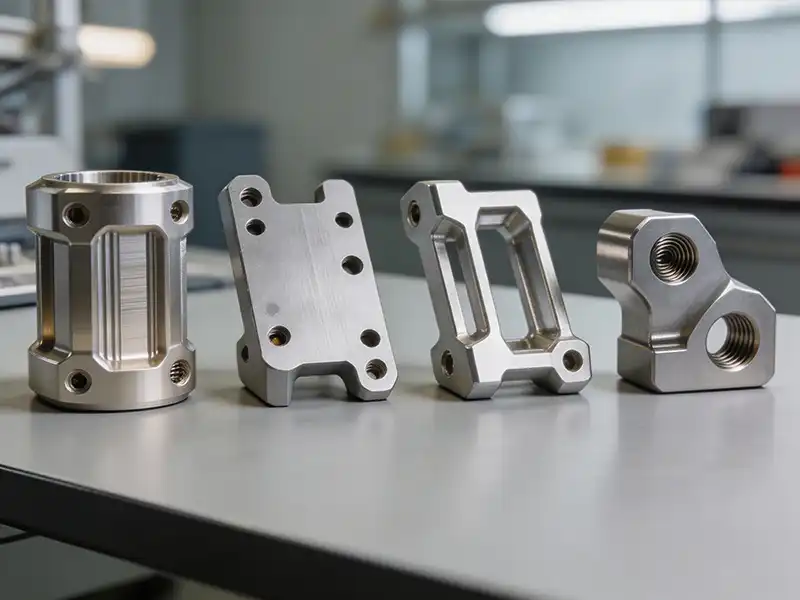
5052: The Corrosion-Resistant, Formable 5xxx Alloy
Non-Heat-Treatable, Work-Hardened Strength
5052 belongs to the 5xxx (Al-Mg) family, which cannot be heat-treated — its strength comes from cold working (H32/H34 tempers). It offers ~228 MPa tensile strength in H32, excellent weldability, and the best saltwater corrosion resistance of the three alloys.
The Marine & Deep-Draw Choice
5052 is the standard for sheet metal fabrication: deep drawing, bending, and forming without cracking. Its high magnesium content gives outstanding corrosion resistance, but causes grey smut during anodizing — so 5052 parts are typically left mill finish or powder coated.
| Property | 5052-H32 |
|---|---|
| Alloy Series | 5xxx (Al-Mg), non-heat-treatable |
| Tensile Strength | ~228 MPa |
| Yield Strength | ~193 MPa |
| Corrosion Resistance | Excellent (marine) |
| Formability | Excellent (deep draw) |
| Anodizing | Poor (grey smut) |
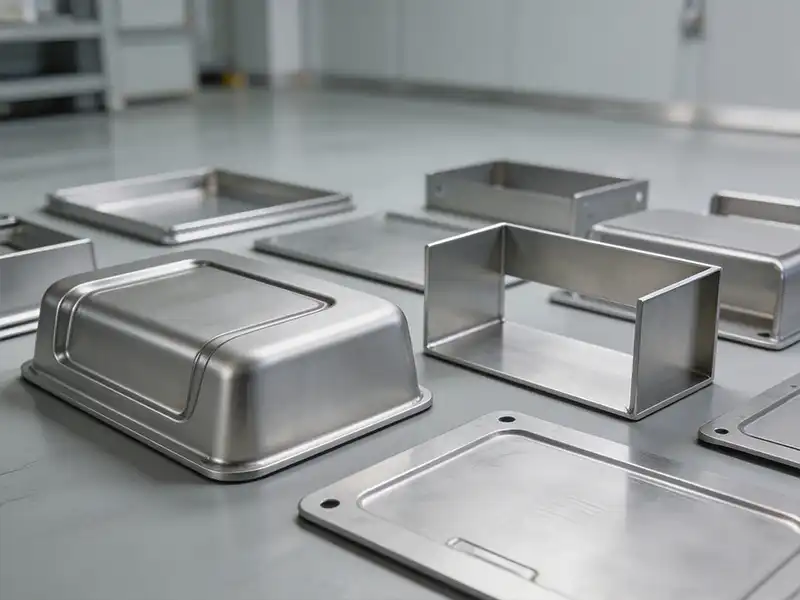
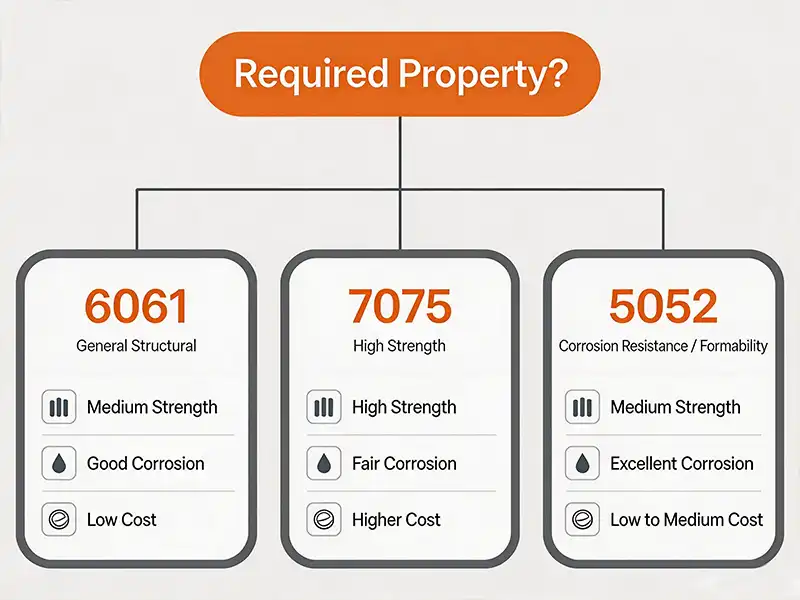
Aluminum Alloy Selection & Application Decision Matrix
Selecting the optimal aluminum alloy balances strength requirements, environmental exposure, formability, and raw material budget. Use the decision matrix below to shortlist the right alloy for your application.
| Industry Application | Recommended Alloy | Key Decision Rationale |
|---|---|---|
| Marine & Outdoor Equipment | 5052 (H32) | Best saltwater corrosion resistance and formability; mill finish or powder coat. |
| Aerospace & High-Load Structural | 7075 (T6) | Ultimate strength-to-weight; requires corrosion protection (anodize/clad). |
| Electronics Enclosures & CNC Parts | 6061 (T6) | Balanced strength, machinability, and best anodizing for cosmetic housings. |
| Cost-Sensitive Sheet Metal | 5052 / 6061 | 5052 for formability; 6061 where anodizing or higher strength is required. |
XRF Spectrometry Alloy Verification
Every incoming aluminum lot undergoes positive material identification (PMI) with handheld XRF analyzers to guarantee exact alloy composition before cutting or machining.
DFM Optimization & Cost Engineering
Our engineers analyze your CAD to match the right alloy — 6061, 7075, or 5052 — to your strength, corrosion, and finish requirements without overspending.
Precision CNC Machining & Anodizing
High-precision CNC machining for 6061/7075 tolerances down to ±0.01mm, plus decorative hardcoat anodizing with color matching for cosmetic housings.
Full Material Certification
All shipments include EN 10204 3.1 Material Test Reports (MTR) with chemical analysis, tensile strength, and hardness results.
Q1: What is the main difference between 6061 and 7075 aluminum?
7075 has roughly 1.6–1.8× the strength of 6061 (due to zinc alloying), but 6061 offers better corrosion resistance, weldability, and anodizing. 6061 is the general-purpose choice; 7075 is for high-load, weight-critical parts.
Q2: Which aluminum alloy is best for marine or saltwater environments?
5052 (5xxx) offers the best saltwater corrosion resistance and is the standard for marine sheet metal. 6061 can be used with anodizing, while 7075 requires protective coating due to stress-corrosion sensitivity.
Q3: Can 7075 aluminum be welded?
7075 is difficult to weld — it is prone to hot cracking and the heat-affected zone loses strength. For welded assemblies, specify 6061 or 5052 instead.
Q4: Which alloy is best for CNC machining?
6061 is the best all-around machining alloy (excellent chip control, tight tolerance). 7075 machines well too and gives higher strength, but is more expensive. 5052 is soft and gummy, making it harder to machine cleanly.
Q5: Which aluminum alloy anodizes best?
6061 anodizes best, producing clear and colored finishes with consistent results. 7075 anodizes to a darker, less uniform tone, and 5052 develops grey smut due to high magnesium — use powder coating for 5052 color needs.
Q6: How much more expensive is 7075 compared to 6061?
7075 typically costs 40–60% more than 6061 due to higher zinc and alloying costs. Specify 7075 only where its strength advantage is actually required.
Q7: Is 5052 aluminum heat-treatable?
No. 5052 is a non-heat-treatable 5xxx alloy; its strength comes from cold working (H32/H34 tempers). Welding or heating 5052 softens the material and cannot be restored by heat treatment.
Q8: How does Conwhole ensure aluminum alloy grade compliance?
Conwhole verifies every incoming aluminum lot with handheld XRF spectrometry (PMI) and provides EN 10204 3.1 Material Test Reports (MTR) with chemical analysis and mechanical properties with every shipment.
Need Technical Guidance on Aluminum Alloy Selection?
Send your custom hardware STEP files, 2D drawings, or operating environment requirements. Conwhole’s engineering team will recommend the optimal alloy, validate DFM, and provide a cost analysis within 24 hours.