
9 MIN READ
How to Choose a Custom Metal Fabrication Supplier
A procurement guide for sourcing managers and buyers evaluating custom metal fabrication suppliers on capability, quality systems, engineering support, and total landed cost.
Key Takeaways for Procurement & Sourcing Teams
- Match Capability, Not Just Price: Verify the supplier’s equipment list maps to your part geometry and tolerances — laser cutting, CNC machining, welding, stamping, and finishing must all exist under one roof to avoid hand-off quality risk. The lowest quote often costs more after rework.
- Quality Evidence Is Non-Negotiable: Incoming material certification (EN 10204 3.1 MTR), and in-process inspection capability (CMM, XRF) — these separate repeatable suppliers from one-off shops.
- Engineering Support ≠ Sales Talk: A supplier that performs DFM review before quoting (not just pricing your drawing) typically saves 20–40% on manufacturing cost and weeks of rework.
- Landed Cost Beats Unit Price: Always factor tooling amortization, MOQ, freight, duties, and scrap rate. Evaluate total cost of ownership, not the per-piece quote.
The Supplier Selection Dilemma in Custom Metal Sourcing
Choosing the wrong metal fabrication supplier is the single most expensive mistake in custom manufacturing — it shows up late, after parts are already in transit, as dimensional rejects, missed tolerances, or corrosion failures. The problem is that most RFQ processes over-weight unit price and under-weight capability fit and quality systems.
This guide gives you a structured, six-dimension framework to vet suppliers — from capability coverage and quality certifications to engineering support, communication, scalability, and traceability — so you can separate repeatable manufacturing partners from one-off job shops.
Conwhole runs laser cutting, CNC machining, welding, and stamping in-house, with surface finishing coordinated through vetted partners, so a single drawing can move from DFM review to certified production without outsourced hand-offs.
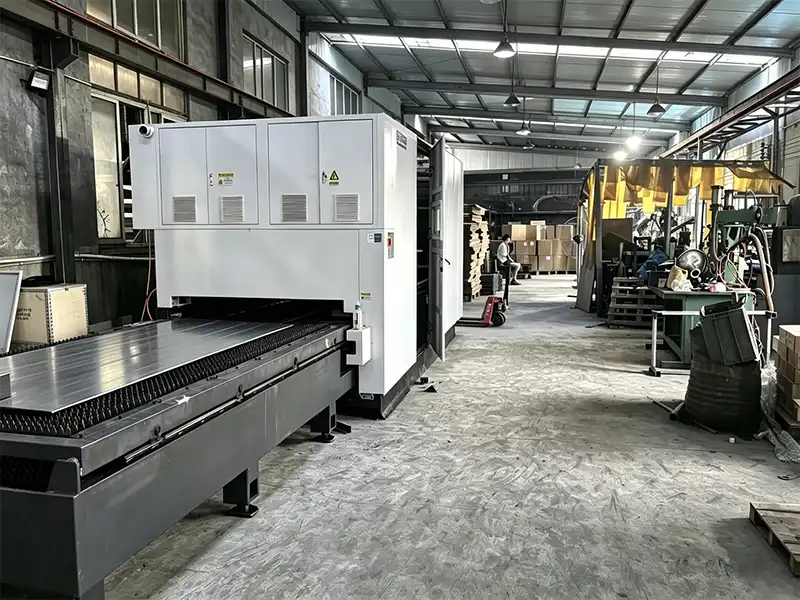
Capability Match: Why One-Stop Coverage Matters
Map Equipment to Your Part, Not the Supplier’s Brochure
Every custom part has a specific manufacturing route — laser cutting for blanks, press brake for bending, CNC for tight tolerances, welding for assemblies, and surface finishing for protection. When a supplier outsources even one of these steps, you inherit a second vendor’s lead time, quality variance, and communication overhead.
The Hand-Off Risk Multiplier
Each outsourced step multiplies defect risk and lead time. A supplier with laser cutting, CNC machining, welding, stamping, and finishing under one roof keeps dimensional control, material traceability, and schedule ownership in a single accountable team — the difference between a smooth launch and a rework spiral.
| Process | One-Stop Supplier | Multi-Vendor Chain |
|---|---|---|
| Dimensional Control | Single accountable team | Split ownership, finger-pointing |
| Lead Time | Single schedule, predictable | Compounded transit + queue time |
| Material Traceability | Full chain, one system | Breaks at each hand-off |
| Cost | No markup on outsourced steps | Each vendor adds margin |
| Communication | One project manager | Multiple contacts, delays |
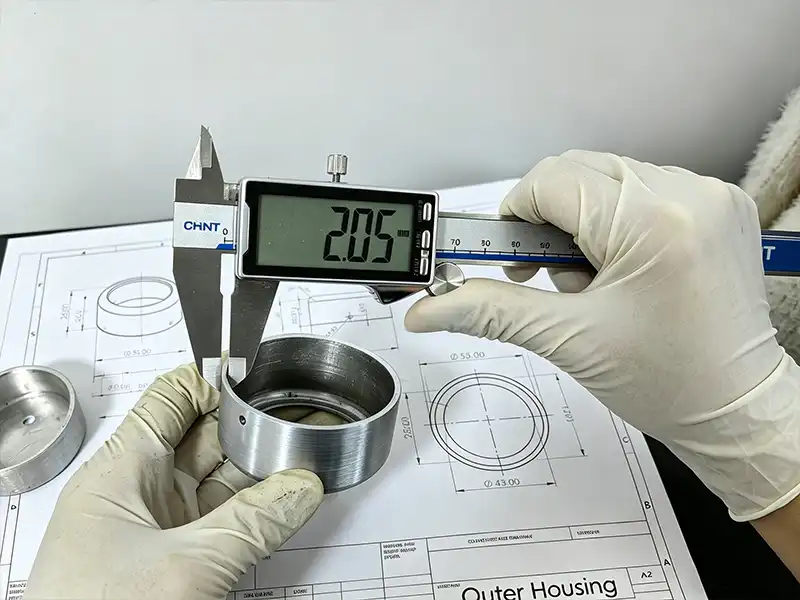
Quality Systems: The Non-Negotiable Evidence
Certifications Separate Repeatable from One-Off
A certificate on the wall means little without the processes behind it. What matters is whether the supplier can produce objective evidence: material test reports, in-process dimensional data, and final inspection records tied to your specific lot.
What to Demand Before You Commit
Before placing a production order, require the supplier to demonstrate incoming material certification, in-process inspection capability, and a documented corrective-action process — the three pillars of repeatable metal fabrication quality.
| Quality Evidence | What It Verifies |
|---|---|
| ISO 9001 | Documented, audited quality management system |
| IATF 16949 | Automotive-grade defect prevention and traceability |
| EN 10204 3.1 MTR | Material composition and mechanical properties per lot |
| CMM Inspection | Dimensional accuracy against CAD tolerances |
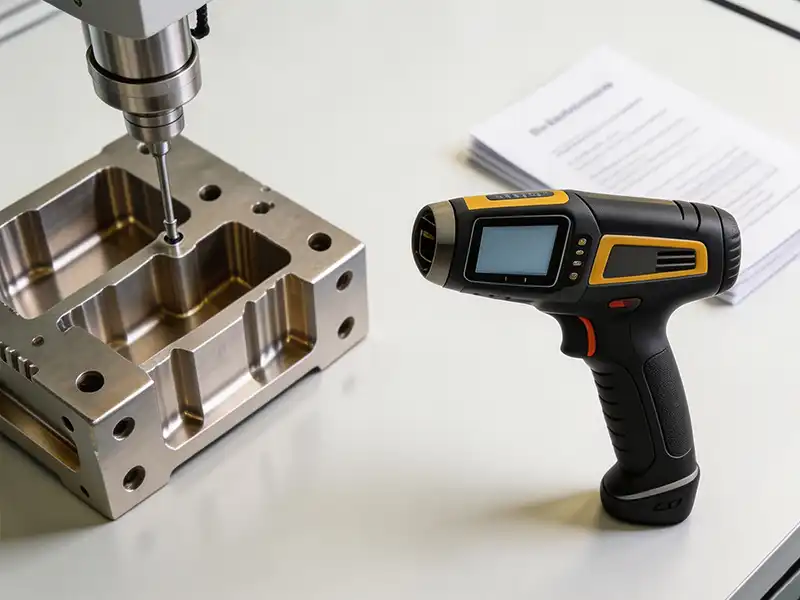
| XRF Spectrometry | Positive material identification before machining |
| PPAP / FAI | First-article validation for production approval |
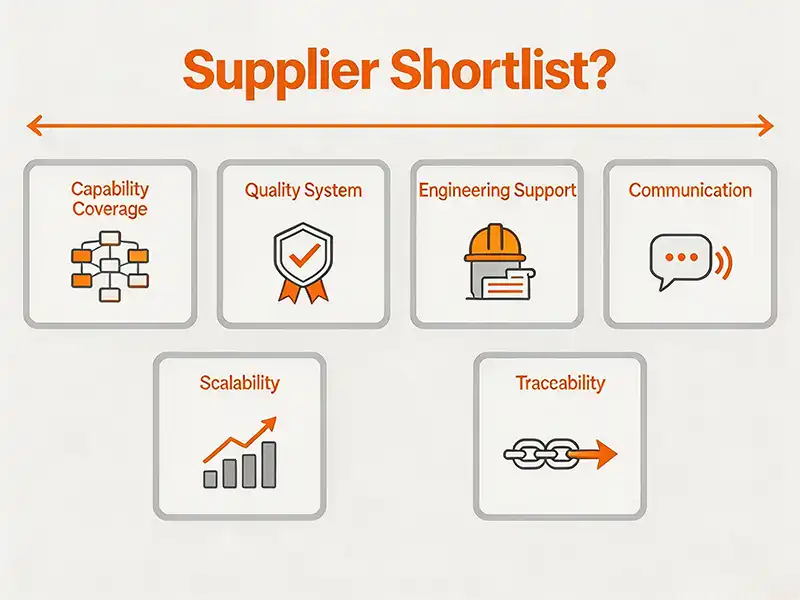
Supplier Evaluation & Selection Decision Matrix
Use this six-dimension matrix to score and compare metal fabrication suppliers. Weight each dimension by your part’s risk profile — aerospace and automotive buyers should double-weight quality systems and traceability.
| Evaluation Dimension | What to Verify | Red Flags |
|---|---|---|
| Capability Coverage | Laser, CNC, welding, stamping in-house; finishing via partners | Multiple outsourced process steps |
| Quality System | ISO 9001 / IATF 16949, MTR, CMM, XRF | No documented QC, no material certs |
| Engineering Support | DFM review, tolerance feedback, prototyping | Quote without questions |
| Communication | Dedicated PM, 24h response, English | Slow replies, no single contact |
| Scalability | MOQ flexibility, capacity headroom | Inflexible MOQ, long lead times |
| Traceability | Batch records, PPAP/FAI, change control | No lot traceability |
One-Stop In-House Capability
Laser cutting, CNC machining, welding, stamping, and surface finishing coordinated through partners — single-team accountability from raw material to finished part.
DFM Engineering Support
Our engineers review your CAD before quoting — recommending tolerance, material, and process changes that typically cut manufacturing cost by 20–40%.
Certified Quality & Traceability
ISO 9001 quality management, EN 10204 3.1 material certs, CMM and XRF inspection, and full lot traceability with PPAP/FAI documentation.
Responsive Global Delivery
Dedicated project manager, 24-hour quote turnaround, and flexible MOQ — from prototypes to full production runs shipped worldwide.
Q1: What is the most important factor when choosing a metal fabrication supplier?
Capability fit beats price. A supplier whose equipment matches your part geometry and tolerances — and who controls every process step in-house — will deliver more predictable quality than the lowest bidder who outsources half the work.
Q2: What certifications should a metal fabrication supplier have?
For automotive or high-risk parts, require IATF 16949. Beyond certificates, demand EN 10204 3.1 material test reports, CMM dimensional reports, and XRF material verification for your specific lots.
Q3: How do I verify a supplier’s real manufacturing capability?
Ask for a machine list and map it to your parts. Better yet, request a factory audit or video walkthrough. A supplier with laser cutting, CNC, welding, stamping, and finishing in one facility eliminates hand-off risk that a multi-vendor chain introduces.
Q4: Why should a supplier review my drawing before quoting?
DFM (design for manufacturability) review catches tolerance, material, and process issues before production. A supplier who asks questions and suggests improvements before quoting typically saves 20–40% on manufacturing cost and avoids rework.
Q5: Should I choose the supplier with the lowest unit price?
Not necessarily. Evaluate landed cost — unit price plus tooling amortization, MOQ, freight, duties, and scrap rate. The cheapest quote frequently costs more after rework, late delivery, and quality failures.
Q6: What is a reasonable MOQ for custom metal fabrication?
It varies by process — laser cutting and CNC machining can start from 1 piece, while stamping requires tooling that favors higher volumes. A good supplier offers flexible MOQ for prototyping and scales to production as demand grows.
Q7: How can I confirm material grade compliance before production?
Require positive material identification (PMI) via XRF spectrometry on incoming lots, plus EN 10204 3.1 MTR documentation. This guarantees the exact alloy or grade is used, not a cheaper substitution.
Q8: How do I start a quote with a new metal fabrication supplier?
Send your STEP files, 2D drawings, and quantity requirements. A reliable supplier responds with a DFM review, material recommendations, and a cost analysis — typically within 24 hours — before you commit.
Ready to Vet a Reliable Fabrication Partner?
Send your custom hardware STEP files, 2D drawings, or quantity requirements. Conwhole’s engineering team will provide a DFM review, material recommendation, and a cost analysis within 24 hours.