
TIG vs MIG Welding
Weld quality, penetration, speed, cost and appearance compared — the engineering breakdown that tells you whether TIG or MIG is the right arc welding process for your parts.
Key Takeaways for Procurement & Engineering Teams
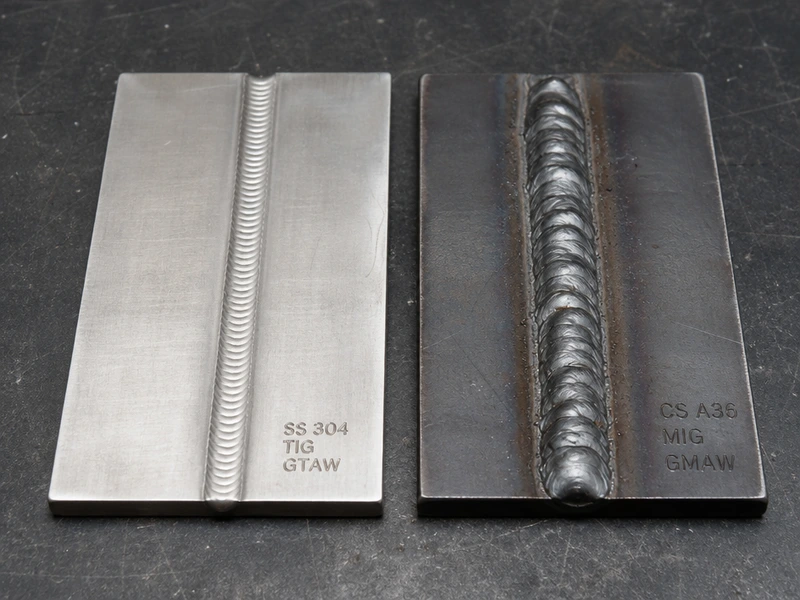
1. Weld Quality & Appearance: TIG produces fine, uniform fish-scale beads with a clean cosmetic finish — the go-to for thin materials, stainless steel, aluminum and visible joints. MIG produces wider beads with deeper penetration — better for thick sections and structural work.
2. Speed & Cost: MIG deposits metal faster, so it wins on cost and throughput for production runs. TIG is slower and more labor-intensive, so it costs more per meter — reserve it for quality-critical and cosmetic joints.
3. Thickness Range: TIG suits 0.5–10 mm; MIG handles 1.5–50 mm with multi-pass bevel welding for heavy gauge.
4. Material Fit: Both weld stainless steel, carbon steel, aluminum, copper alloys and titanium — but TIG is preferred for thin aluminum and exotic alloys, while MIG favors thicker carbon steel and high-volume runs.
On this page
1. The trade-off → 2. TIG welding → 3. MIG welding → 4. Selection matrix → 5. Why Conwhole → 6. FAQ →
Two Arc Processes, Two Different Trade-Offs
TIG and MIG are the two most widely used arc welding processes in custom metal fabrication — but they produce very different welds through very different physics. TIG (GTAW) uses a non-consumable tungsten electrode for slow, precise, clean welds. MIG (GMAW) feeds a consumable wire electrode for fast deposition and deep penetration.
Choosing wrong either overpays for finish quality you don’t need, or produces welds that won’t meet appearance or strength requirements. This guide breaks down both processes across the four factors that matter to sourcing — weld quality and appearance, penetration and thickness range, speed and cost, and material fit — then gives you a side-by-side selection matrix to match the process to your part. Conwhole operates both TIG and MIG in-house, so you get an honest process recommendation rather than one process forced onto every job.
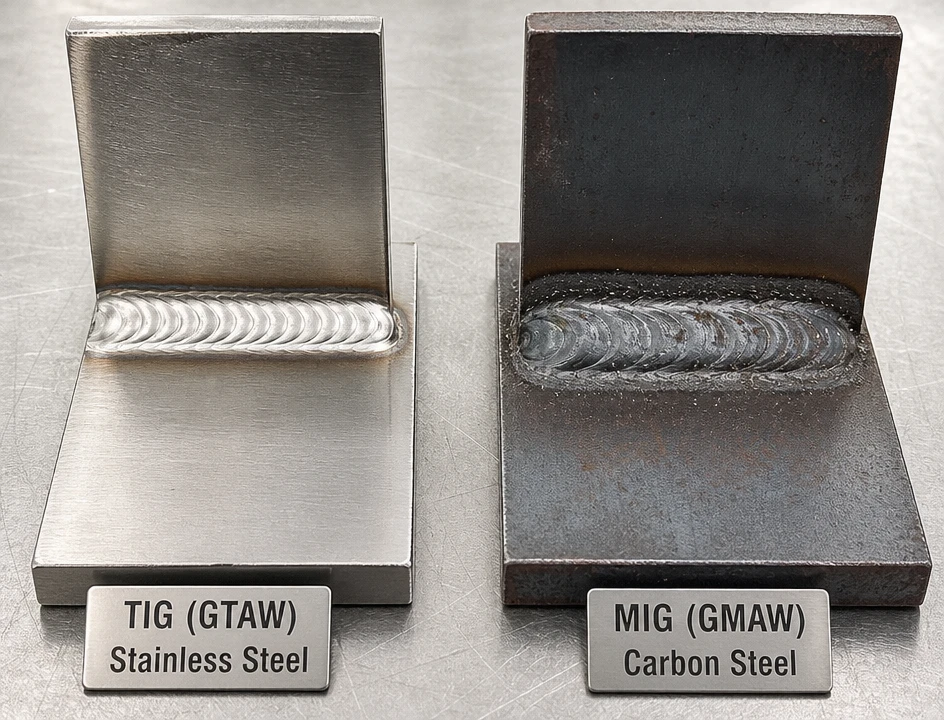
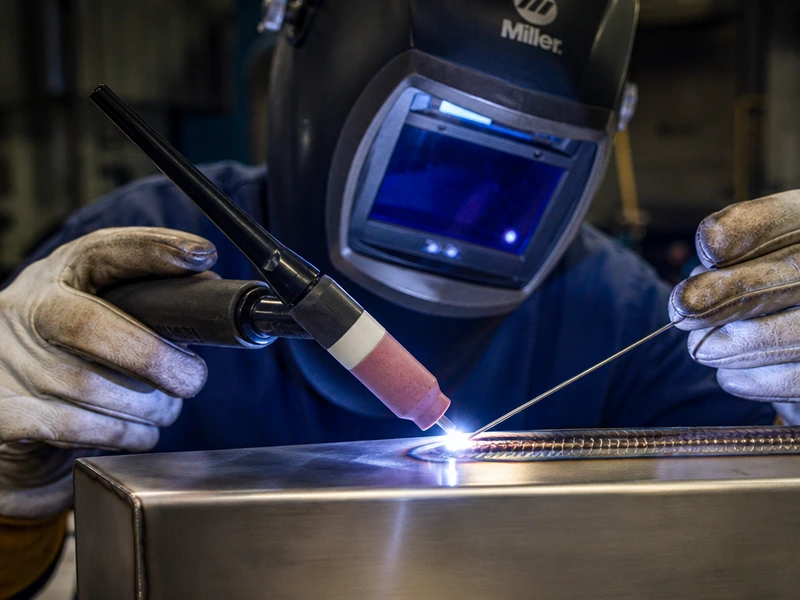
TIG Welding: The Precision Finisher
| Parameter | TIG Welding (GTAW) |
|---|---|
| Full process name | Gas Tungsten Arc Welding |
| Electrode | Non-consumable tungsten electrode |
| Weld appearance | Fine, uniform fish-scale beads |
| Material thickness | 0.5 – 10 mm |
| Speed | Slow — precision-focused |
| Shielding gas | Pure argon, argon + helium mix |
| Heat input | Low and controlled — minimal distortion on thin sheet |
| Post-weld | Minimal grinding; often left as-welded |
| Position capability | All positions (flat, horizontal, vertical, overhead) |
| Best for | Thin materials, stainless steel, aluminum, exotic alloys, cosmetic joints |
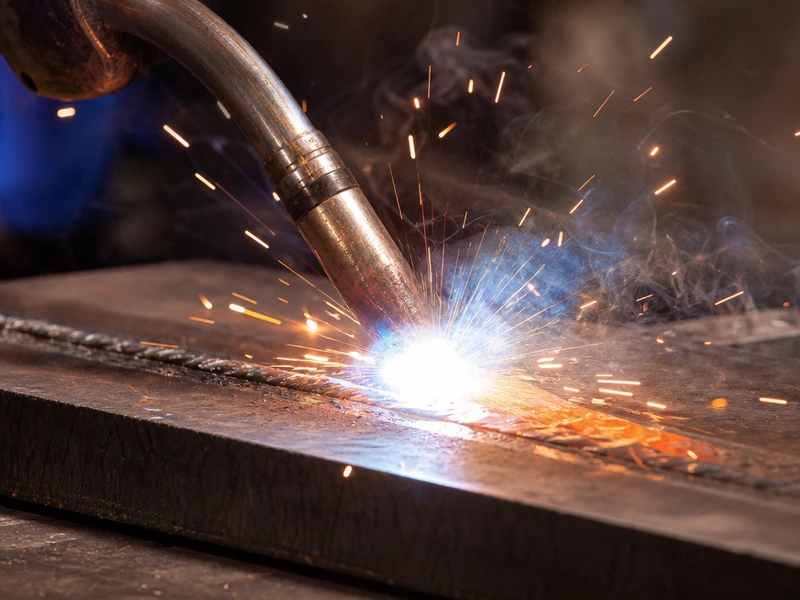
MIG Welding: The Production Workhorse
| Parameter | MIG Welding (GMAW) |
|---|---|
| Full process name | Gas Metal Arc Welding |
| Electrode | Consumable wire electrode |
| Weld appearance | Wider beads, deeper penetration |
| Material thickness | 1.5 – 50 mm (multi-pass bevel welding for heavy gauge) |
| Speed | Fast — production-focused |
| Shielding gas | Pure CO₂, argon + CO₂ mix |
| Heat input | Higher — faster deposition, more distortion risk on thin sheet |
| Post-weld | Grinding and finishing usually required |
| Position capability | All positions (flat, horizontal, vertical, overhead) |
| Best for | Thick materials, carbon steel, high-volume production |
TIG vs MIG: Selection Matrix
Match the process to your part. TIG wins on cosmetic quality and thin-gauge control; MIG wins on thickness, speed and cost. Use this matrix to shortlist before you request a quote.
| Selection Factor | TIG Welding | MIG Welding |
|---|---|---|
| Precise, cosmetic weld | Best choice | Acceptable (needs finishing) |
| Thin sheet (<3 mm) | Best choice | Risk of burn-through |
| Thick section (>10 mm) | Slow, costly | Best choice |
| High-volume production | Slow, labor-intensive | Best choice |
| Aluminum & exotic alloys | Best choice | Workable |
| Lowest cost per meter | Higher | Best choice |
Why Choose Conwhole for TIG & MIG Welding
Licensed Welders
Government-issued welding operation licenses and years of hands-on experience, with documented procedures and traceability for every project.
Honest Process Selection
We don’t default to one process. Our engineers select TIG, MIG, or a combination based on your material, thickness, appearance and volume.
Complete Fabrication
Cutting, bending, machining and finishing handled in-house — one facility, one point of contact, no multi-supplier delays.
Inspection & Testing
Visual (VT), dye penetrant (PT), magnetic particle (MT), ultrasonic (UT) and radiographic (RT) testing, with first-article reports.
Q1: What is the main difference between TIG and MIG welding?
TIG uses a non-consumable tungsten electrode to produce precise, clean welds — ideal for thin materials, stainless steel, aluminum and cosmetic joints. MIG feeds a consumable wire electrode for faster deposition and deeper penetration — better for thicker materials, carbon steel and high-volume production.
Q2: Which process is better for thin sheet metal?
TIG. Its low, controlled heat input minimizes distortion and burn-through on thin sheet, and it produces a clean bead that often needs no grinding.
Q3: Which process is better for thick structural steel?
MIG. Its higher deposition rate and deeper penetration make it faster and cheaper on thick sections, up to 50 mm with multi-pass bevel welding.
Q4: Which process gives a better-looking weld?
TIG produces the finer, more uniform fish-scale beads with a clean appearance. MIG welds are wider and typically need grinding or finishing for cosmetic surfaces.
Q5: Which is cheaper, TIG or MIG?
MIG is cheaper per meter because it deposits metal faster. TIG is slower and more labor-intensive, so it costs more — reserve it for quality-critical and cosmetic joints.
Q6: Can you weld aluminum with both TIG and MIG?
Yes. Both processes weld aluminum, but TIG is preferred for thin aluminum and cosmetic work, while MIG is used for thicker sections and higher volumes. We weld aluminum grades 5052, 6061 and 6063.
Q7: Does Conwhole run both TIG and MIG in-house?
Yes. Both processes are in-house, along with cutting, bending, machining and finishing — so your project flows through one facility with a single point of accountability.
Related reading
Ready to Get Your Parts Welded the Right Way?
Send your STEP files, 2D drawings, or material and thickness specs. Conwhole’s engineers will recommend the best-fit welding process — TIG, MIG, or a combination — and deliver a unit price quote within 24 hours.